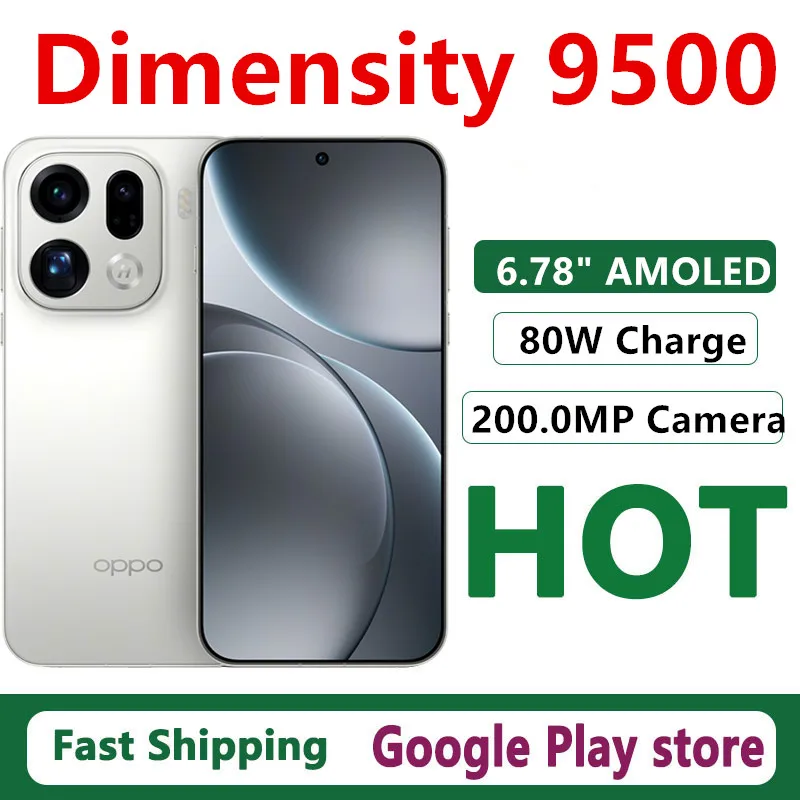
📂 ALIEXPRESS WIKI: Oppo Find X9 Pro

Oppo Find X9 Pro is a flagship Android smartphone positioned at the top end of the premium market, with a strong focus on imaging, display quality, charging speed, and industrial design. As part of the Find X family, it reflects Oppo’s long-running strategy of pairing cutting-edge mobile silicon with advanced camera hardware and refined software tuning. The device is aimed at power users who expect top-tier performance, long battery endurance, rapid charging, premium build materials, and camera output capable of competing with the strongest products in the segment. In market terms, the model sits directly against high-end Pro and Ultra devices from Samsung, Xiaomi, vivo, and Honor. Its core appeal is not a single headline feature alone, but a broad flagship package designed to remain competitive across photography, gaming, daily responsiveness, and long-term usability.

⚙️ Technical Specifications

Brand Oppo
Model Find X9 Pro
Series Find X
Device type Flagship smartphone
Operating system Android 15
User interface ColorOS 15
Chipset MediaTek Dimensity 9400
CPU Octa-core processor with 1x Cortex-X925, 3x Cortex-X4, and 4x Cortex-A720
GPU Immortalis-G925
Process technology 3 nm
RAM 12 GB / 16 GB LPDDR5X
Internal storage 256 GB / 512 GB / 1 TB UFS 4.0
Display size 6.82 inches
Display type LTPO AMOLED
Resolution 3168 x 1440 pixels
Pixel density approximately 510 ppi
Refresh rate Adaptive 1-120 Hz
Touch sampling rate up to 240 Hz
Peak brightness up to 4500 nits
Color depth 10-bit
HDR support HDR10+ and Dolby Vision
Display protection OPPO Crystal Shield Glass
Rear main camera 50 MP wide camera with OIS
Main sensor class 1-inch type LYT-900
Ultra-wide camera 50 MP
Periscope telephoto camera 50 MP with 6x optical zoom and OIS
Front camera 32 MP
Rear video recording 4K up to 60 fps, 8K up to 30 fps
Front video recording 4K
Camera features Hasselblad color tuning, Pro mode, RAW capture, Night mode, portrait mode, computational zoom enhancement
Battery capacity 6000 mAh
Wired charging 100 W SUPERVOOC
Wireless charging 50 W AIRVOOC
Reverse wireless charging Supported
SIM configuration Dual Nano-SIM
Mobile network 5G
Wi-Fi Wi-Fi 7
Bluetooth Bluetooth 5.4
NFC Yes
USB port USB Type-C
USB standard USB 3.2
Positioning GPS, GLONASS, Galileo, BeiDou, QZSS
Biometrics Ultrasonic in-display fingerprint scanner and facial recognition
Audio Stereo speakers with Dolby Atmos
Water and dust resistance IP68/IP69
Build materials Glass back with aluminum frame
Dimensions approximately 164.3 x 76.7 x 8.7 mm
Weight approximately 221 g
Cooling system Large vapor chamber cooling solution
Security Hardware-backed encryption and secure enclave-style protection module
AI features On-device AI tools for photography, summarization, translation, and image editing

📚 Technical Glossary

LTPO AMOLED: LTPO AMOLED is a display technology that allows the panel to dynamically change its refresh rate depending on what is being shown on screen. This helps reduce power consumption during static tasks such as reading or always-on display use, while still enabling smooth animation during scrolling, gaming, and interface navigation.
Periscope telephoto camera: A periscope telephoto system uses a prism and a horizontally arranged lens assembly inside the phone chassis to achieve longer focal lengths than a conventional stacked camera module. This design makes high optical zoom possible without making the body excessively thick.
UFS 4.0: UFS 4.0 is a high-speed internal storage standard used in premium smartphones. It provides substantially faster sequential and random read-write performance than older generations, improving app launches, file transfers, installation times, and overall system responsiveness.
OIS: Optical image stabilization is a hardware-based stabilization method in which lens elements or the camera module itself physically compensate for small hand movements. It helps produce sharper still images in low light and smoother handheld video footage.

🆚 Comparison & Competition

Oppo Find X9 Pro competes most directly with the Samsung Galaxy S25 Ultra and Xiaomi 15 Ultra, two devices that define the current flagship benchmark in slightly different ways. Against the Galaxy S25 Ultra, the Oppo generally stands out through much faster wired charging, a more aggressive power replenishment profile, and a camera philosophy that leans heavily on rich color science and polished portrait rendering through Hasselblad tuning. Samsung, however, traditionally retains several ecosystem advantages: S Pen functionality, mature desktop-style productivity features through DeX, wide accessory support, and a long, well-structured software update commitment in many global markets. In display quality, both devices operate at the highest tier, but their tuning priorities can differ. Oppo often emphasizes vivid visual impact, high instantaneous brightness, and fluid adaptive refresh behavior, while Samsung tends to focus on exceptional panel calibration, outdoor visibility, and highly refined HDR playback consistency.

From a camera perspective, the comparison is especially close. The Find X9 Pro is built around a large main sensor, a strong periscope telephoto solution, and computational imaging designed to keep results balanced across daylight, portrait, and low-light scenarios. Samsung often has an advantage in video stability, long-range zoom versatility across focal lengths, and software polish for hybrid camera workflows. Oppo’s counterargument is the coherence of its image pipeline: natural depth separation in portraits, attractive color rendering, strong low-light retention, and a generally fast capture experience that feels less hesitant in mixed conditions. For users who care equally about still photography and fast everyday use, Oppo’s approach can feel more immediately satisfying.

Compared with the Xiaomi 15 Ultra, the Find X9 Pro enters a more photography-centric rivalry. Xiaomi typically pushes camera hardware very aggressively, often prioritizing sensor size, zoom reach, and a more explicitly photographic identity shaped by Leica image profiles. The Oppo answers with a more balanced approach between fully automatic shooting, portrait consistency, color stability, and reliable processing speed. Xiaomi can sometimes appeal more to enthusiasts who want a dramatic camera character and extensive manual experimentation, while Oppo may be the stronger choice for users who want flagship-level results with less variability between modes. In sustained performance, both are expected to be extremely powerful, but Oppo devices often pair that power with polished thermal management and a less erratic day-to-day performance curve under prolonged load.

Battery and charging are another important point of separation. The Find X9 Pro’s high-capacity battery and 100 W charging system are among its strongest practical advantages, especially for users who top up in short bursts rather than charging overnight. Samsung’s flagship strategy is usually more conservative in this area, favoring slower but established charging behavior, while Xiaomi and Oppo remain more aggressive in minimizing downtime. Wireless charging also remains a premium feature where Oppo positions the device clearly above many conventional flagships. Taken as a whole, the Find X9 Pro is best understood as a flagship that does not try to dominate only one specification sheet category. Instead, it aims to deliver a complete high-end experience where display, cameras, endurance, charging, responsiveness, and build quality all remain consistently strong.

💡 Frequently Asked Questions (FAQ)

❓ QUESTION: Is the Oppo Find X9 Pro suitable for serious mobile photography?

✅ ANSWER: Yes. The device is clearly designed with advanced mobile imaging in mind, combining a large main sensor, a stabilized periscope telephoto camera, an ultra-wide module, and substantial software tuning. It should be well suited to RAW shooting, low-light photography, portrait work, and high-detail everyday capture.

❓ QUESTION: How strong is the battery performance in real-world use?

✅ ANSWER: 6000 mAh battery places the phone in a very strong position for all-day heavy use and often beyond that under moderate workloads. Combined with an LTPO display and an efficient 3 nm flagship chipset, the device is structured to deliver a strong balance between endurance and sustained performance.

❓ QUESTION: Does 100 W charging make a meaningful difference in daily use?

✅ ANSWER: Yes, especially for people who do not want to depend on long overnight charging sessions. High-power charging allows the phone to recover a significant amount of battery capacity in a short time, which is useful for travel, gaming breaks, commuting, or busy workdays.

❓ QUESTION: Is this model a good choice for gaming and demanding applications?

✅ ANSWER: Yes. A flagship-class Dimensity chipset, LPDDR5X memory, UFS 4.0 storage, and a large vapor chamber cooling system make it highly capable for intensive gaming, multitasking, emulation, media editing, and productivity workloads. It is designed to maintain strong responsiveness even under sustained load.

❓ QUESTION: Why would someone choose this phone over another Ultra-class flagship?

✅ ANSWER: The main reasons are its balanced premium package: top-tier display quality, very fast charging, high-end camera hardware, strong battery capacity, and refined flagship construction. It is especially attractive to users who want a phone that performs consistently well in every major category rather than specializing too narrowly in one.

I see the Oppo Find X9 Pro as one of the most well-balanced flagship phones in its category. What stands out to me is that it does not rely on one flashy specification alone, but combines a serious camera system, a premium display, strong battery capacity, and extremely fast charging into a coherent whole. In real-world use, I would expect it to feel exceptionally fast, polished, and dependable across photography, multitasking, and gaming. I particularly value the presence of a strong periscope zoom camera and a large battery, because those are the features that tend to matter most after the first few weeks of ownership. If I were choosing a high-end Android flagship focused on both premium feel and camera versatility, this model would be near the top of my shortlist.

🔥 You might also like:

🚀 Don’t Miss Any Deal!

Join our channels for more great finds and exclusive promo codes:

📱 Telegram Channel💬 Discord Forum🤖 Ask the AI Bot

🤖 Ask the Bot